
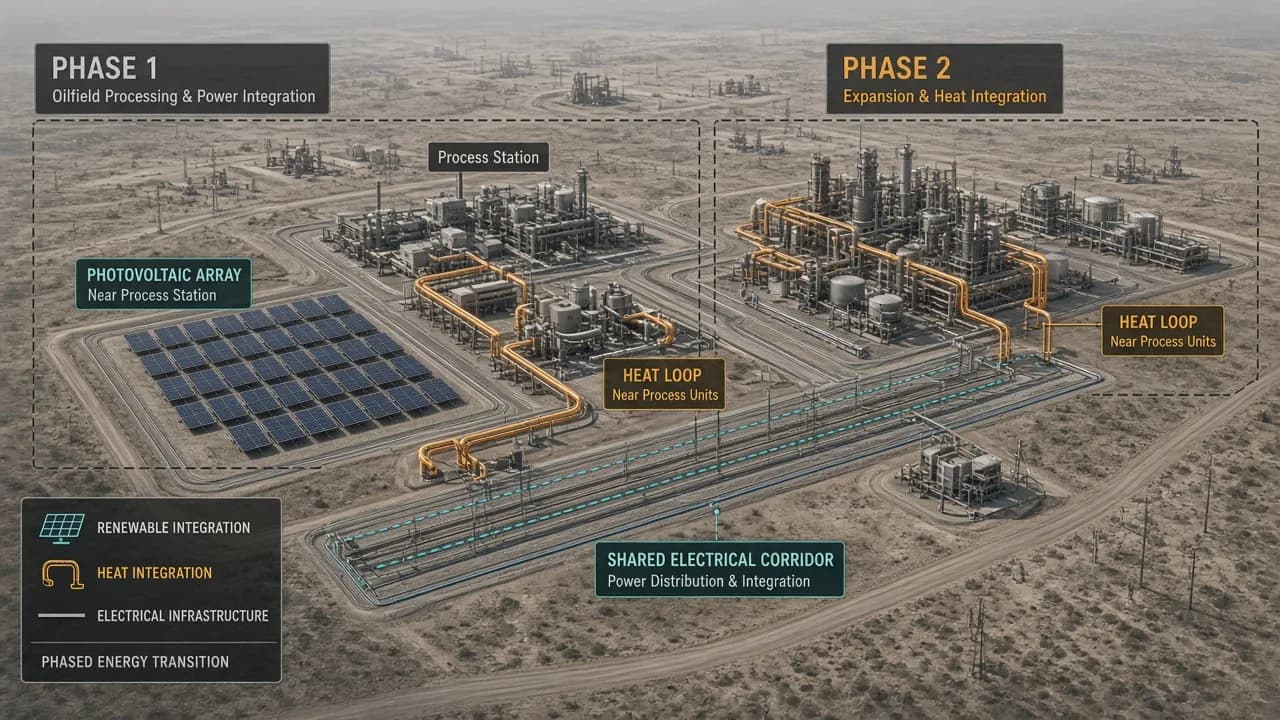
Oilfield renewables do not fail because the technology is weak. They fail when solar, geothermal, waste-heat and hydrogen are funded as disconnected pilots that never reconcile load, land, grid connection, utilities interfaces and operating economics. A portfolio plan is the missing layer: resource-to-load matching, phased bankable concepts, and integration with existing surface systems—so execution inherits a coherent basis instead of eight competing demos.
実用的な要点- State the portfolio question before shopping for a technology: which loads, which sites, which years, and what grid or islanding constraint.
- Match resource to load — PV, mid-deep geothermal, produced-water waste heat, solar thermal, wind and green hydrogen each solve different energy shapes.
- Lock land, right-of-way and interconnection assumptions early; they kill more oilfield renewables than inverter specs.
- Design the interface to gathering, power, water and controls with surface engineering, not as a bolt-on after FEED.
- Phase capital against a bankable concept: portfolio MW/GJ targets first, then project packages that operations can absorb.
- Tie renewables into the carbon and operating-loop story so pilots do not orphan the measurement system.